
Material requirements planning (MRP)
Material requirements planning (MRP) is a production and inventory management method for working out which raw materials and components are needed to make a given quantity of finished products. Its main goal is to make sure that production has the materials and components it needs. It also helps minimise inventory and meet the delivery dates promised to customers.
Plan material requirements with business intelligence
Anticipate stockouts, plan production orders and manage purchasing without implementing a new ERP system or undertaking a complex integration.

Anticipate production needs with business intelligence
Industrial SMEs often struggle to plan production effectively. Between scattered Excel files and complex ERP systems, it can be hard to see what's needed.
With Power BI, Datavizin turns your data into dynamic, predictive dashboards for accurate, adaptable production planning..
An accessible MRP solution
Built on SQL Server, SSIS and Power BI, our MRP solution helps you:
See your short- and medium-term requirements
Optimise inventory and purchasing
Identify delays and anticipate stockouts
Simplify your MRP processes without an expensive ERP
What is material requirements planning for?
MRP precisely determines the quantities of raw materials, components and finished products needed to meet business demand while minimising cost and lead time. Advanced planning tools help manufacturers anticipate changes in demand, avoid stockouts and improve operational efficiency. Material requirements planning is a strategic tool for helping industrial businesses compete more effectively and improve profitability.
Material requirements planning (MRP) is a production and inventory management method for determining which raw materials and components are needed to produce a given number of finished products. It ensures that materials and components are available when production needs them, while minimising inventory and honouring delivery dates. MRP improves inventory management by avoiding both overstocking and stockouts. In the short term, optimising material requirements reduces operational costs by improving the supply chain. Smoother, more efficient production then helps manufacturers improve customer satisfaction.
An approach for Swiss SMEs
Our solutions are designed for industrial SMEs in French-speaking Switzerland that want to digitise planning without heavy infrastructure.
Datavizin hosts and integrates your data flows in a secure, sovereign environment that meets Swiss requirements.
Three steps to put your data to work in production
1️⃣ Free audit of your current processes
2️⃣ Power BI prototype with your own data
3️⃣ Operational deployment of your BI-based MRP solution
Local expertise and support throughout
Datavizin is based in Switzerland and helps SMEs implement business intelligence and data management solutions..
Drawing on our expertise in the Microsoft BI stack, we build custom tools to manage production, inventory and forecasting.
Discover what BI-powered MRP can do
Request a personalised Power BI demo and see what data-driven material requirements planning can do for you.
Industrial SMEs often struggle to:
Bring customer orders, forecasts and stock levels into one reliable view.
Calculate net requirements across multiple bill of materials levels.
See the impact of a supplier delay or urgent order.
👉 The result is decisions without enough information, production delays and misaligned stock levels.
The Datavizin solution
A BI application for material requirements planning that connects to your SQL Server data and runs in Power BI..
Key features:
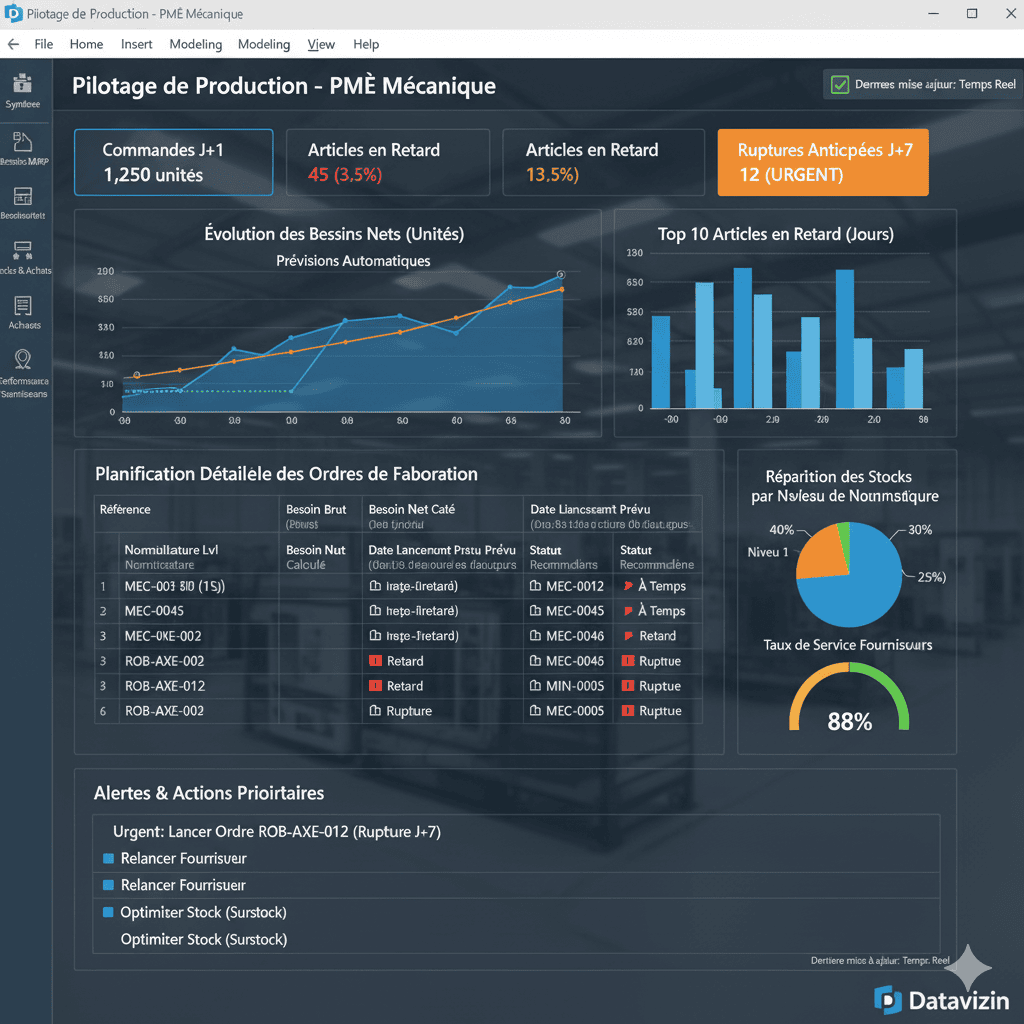
An example
A mechanical engineering SME has 150 product references and three bill of materials levels.
With the Datavizin model:
Requirements are calculated automatically every time orders are updated.
Teams can anticipate delays and stockouts.
The production manager has a clear Power BI report updated in real time.
Who is this for?
Industrial SMEs with 10–200 employees
Companies with no ERP or a limited ERP
Production managers, supply chain teams and technical leadership
Request a free personalised demo
See how a BI-based MRP model can transform the way you manage production.
Who can benefit from automated material requirements planning?
Manufacturers, tradespeople, retailers and service companies can benefit. Wherever businesses buy, sell or move materials through stock, calculating and planning requirements are central to short- and medium-term growth. The calculation is usually time-consuming but relatively straightforward once all relevant factors are in view, including sales orders, purchase orders, stock on hand and in transit, and planned production orders.
Automating MRP can be as strategic as automating a production line. Plan your orders during the day and let the system calculate and adjust your requirements overnight. The next morning you have the information you need to prepare your upcoming orders confidently.
Get started with MRP with our industrial specialists
Submit the form and we will respond within 48 business hours to arrange a video call or an on-site visit in the canton of Fribourg and discuss which solutions fit your needs.

How do you implement automated MRP?
1. Sales plan
The sales plan focuses on commercial activities and defines forecast sales over a given period. That generates material requirements and forms the basis of the MRP calculation.
2. Master production schedule
The master production schedule uses forecast sales to define the volumes needed to meet sales demand. It determines how many finished products must be produced or drawn from stock to fill customer orders.
3. Capacity plan
The capacity plan details which parts must be produced, in what quantities and by which dates to meet customer orders while minimising storage and purchasing costs. For each production order, the plan sets minimum stock levels for each part, replenishment dates and related requirements.
The sources: the company's ERP (enterprise resource planning), MES (manufacturing execution system) and PLM (product lifecycle management) systems.
Sales teams enter orders in the ERP. The MES provides production lead times, and the PLM defines the manufacturing bills of materials. Planning teams then decide how to fill sales orders for finished products, for example from existing stock or through direct production.
Datavizin's automated MRP solution
Production inputs, stock on hand, material purchases, production capacity and customer orders are extracted from the relevant source systems or from the ERP where all the information is centralised.
The MRP process builds the production plan and estimates requirements by answering several questions:
- What quantities have customers been promised, and for what dates?
- What is currently in stock? What parts have been ordered from suppliers, and when will they arrive?
- How long will it take to make each finished product?
- What machine utilisation is expected relative to the specified requirements?
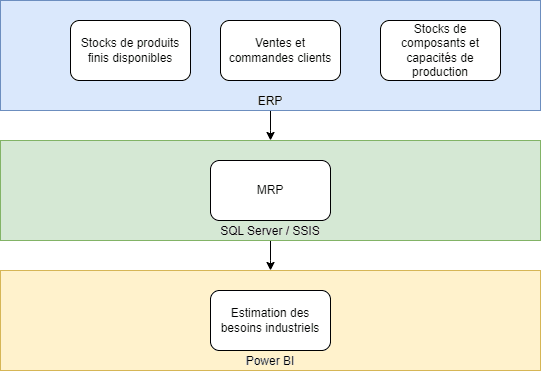
Our MRP solution relies on three main components:
- the company's ERP, CRM, MES and other source systems where the essential data lives
- a series of SSIS (SQL Server Integration Services) programs and packages that aggregate, prepare and consolidate the data from those systems
- a suite of BI dashboards, reports and other tools available in Power BI Desktop or Power BI Server.